
Most homeowners who have been thinking about a landscape project for a while share a common reason for not starting: they don’t feel ready. No clear vision. No firm budget. No idea where to begin. So, the project stays on the back burner, season after season.
Here’s what most people don’t realize: you don’t need a finished plan before reaching out to a landscape designer. That’s their job. What you do need is some basic thinking done before you pick up the phone, so that when you do have that first conversation, it’s productive rather than vague.
This guide covers what to think through before your first consultation, how to evaluate whether a contractor is the right fit, and how to set your project up for success from the start.
Start With How You Want to Live Outdoors, Not What You Want to Build
The instinct most homeowners have is to start with features: “I want an outdoor kitchen” or “we’ve always talked about a firepit.” That’s a reasonable starting point, but the homeowners who end up happiest with their finished projects usually start one step further back, with how they actually want to use the space.
Consider a few questions before your first designer conversation. How do you spend time outside right now, and what stops you from spending more? Do you entertain large groups, or is it mostly immediate family? Do you want to cook outside, eat outside, both? Is shade a priority? Privacy? A space where kids or pets can move freely? Do you want something that requires regular upkeep, or as close to low-maintenance as possible?
The answers to these questions are more useful to a landscape designer than a list of features. Features follow from use. A homeowner who says “we want to eat outside four nights a week and host a big cookout maybe six times a year” gives a designer far better raw material than one who says “we want a patio and maybe an outdoor kitchen.” Both might end up with similar projects, but the first conversation produces a design that actually fits the way the family lives.
Spend some time on this before your consultation. Jot down notes, talk it through with your household, save photos that resonate even if you can’t articulate exactly why. You’ll walk into the first meeting with something genuinely useful.

What to Know About Budget Before Your First Conversation
Budget is the subject most homeowners are least comfortable bringing up, and most contractors are least comfortable asking about directly. The result is a lot of wasted time on both sides.
Coming into a consultation with a rough budget range, even a loose one, makes the conversation significantly more productive. It allows a designer to focus on what’s actually achievable rather than presenting a dream scenario that has to be walked back later.
For Atlanta-area homeowners, here is a general sense of what landscape investment levels look like. A focused project such as a patio, planting refresh, or irrigation installation typically starts in the $15,000 to $45,000 range. A mid-scope backyard transformation involving hardscape, plantings, and lighting generally falls between $50,000 and $90,000. Full outdoor living projects on a luxury level with custom features, outdoor kitchens, fire elements, and extensive hardscape will commonly start at $100,000 and can go well beyond that up into the mid $200,000 range.
These are directional figures, not quotes. Your actual project cost depends on your site, your priorities, and the materials you choose. But knowing which general range you are working in helps a designer know where to focus.
If your budget is firm and a full project isn’t feasible right now, bring that up early. A good designer will help you think about phasing, completing the project in stages over one or two seasons in a way that makes sense structurally and aesthetically rather than just chopping it arbitrarily.
Timing: Why Spring Projects Start in February
In the Atlanta metro area, most homeowners want their outdoor projects completed in time to enjoy them through spring and summer. That’s also when landscape contractors are at peak demand. Many factors can affect project duration times. Whether a client has a lot of revisions, and how quickly they may respond in any interaction has an impact on the timing as well. It is important to note that every project which includes hardscaping now requires permits, and that and should be factored into any possible scheduling.
Landscape Planning and Construction Takes Time
To a large degree, the overall time allotment depends on where the client lives, as not all counties operate in the same way. Clients located inside the City of Atlanta should plan for project times to be in the 6-12 months range overall. The practical reality is that most quality design-build firms are booking installation slots 2-4 months out from the time a project is approved, and the design phase itself takes two to four weeks before that. So plan accordingly and know that getting started during the off-season months is the best choice for tight schedules.
If you want a finished project by May, the math points to starting the conversation by late winter.
Temperatures for Planting Shrubs and Trees Are Ideal In Winter
There is another reason to move early that goes beyond scheduling. Late winter and early spring are genuinely good conditions for hardscape installation and planting in Georgia. Plants installed before the summer heat have time to establish strong root systems before they face stress. The winter landscaping article on the Oasis blog covers this in more detail if you want the full picture. Cooler temperatures are better for setting concrete and stone, as well.
Starting in February doesn’t mean your backyard will be a construction zone in March. It means your design will be done, your materials will be ordered, and your project will be scheduled before the spring rush begins.
Preparing Your Landscape Planning Checklist
You don’t need to arrive with drawings or a detailed brief. A few simple things will make the site visit more useful for both you and the designer.
Inspiration and vision
- Inspiration photos: Save images that resonate with you, even if you can’t fully explain why. Houzz, Pinterest, and Instagram are all useful for this. Designers are skilled at reading what a homeowner responds to visually, even from loosely related images.
- Known features: Note any specific elements you know you want, such as a covered outdoor kitchen, a fire feature, or a water element, so the designer can factor those into the conversation from the start.
Your current space
- Pain points: Write down what frustrates you about your yard as it is now. Poor drainage, no shade, a slope that limits usable space, a lawn you’re tired of maintaining, a view you want to screen. Problems are just as useful as wishes.
- What is working: Note any areas of the property that are working well and should be preserved or incorporated.
Priorities and tradeoffs
- If you had to choose between a longer timeline and reduced scope, which would you prefer? Knowing this helps a designer understand where flexibility exists.
- Identify the one outcome that, if it came out perfectly, would make the whole investment feel worthwhile. This anchors the design priorities when tradeoffs come up later.
Practical site information
- Any known drainage issues, grade problems, or erosion areas.
- HOA restrictions or design guidelines, if applicable.
- Utility easements or shared property line considerations.
- Irrigation system details if one already exists.
- Any recent survey or site plan, if you have one readily available.
Budget
- Come prepared with a range, even a loose one. You don’t need an exact number but knowing whether you’re working with $40,000 or $150,000 shapes the conversation significantly.
What a Good Consultation Looks and Feels Like
A site consultation with a quality landscape contractor should feel like a thoughtful conversation about your property and your goals, not a sales presentation.
The designer should walk your entire property, not just the area you’ve identified as the project zone. They should ask about how you use the space, what you dislike about it, and what you’re hoping for. Our designer should notice things and point them out: drainage concerns, sun patterns, grade changes, mature trees worth designing around rather than removing. They should be honest about challenges, not just enthusiastic about possibilities.
You should feel heard rather than managed. A good first consultation leaves you with a clearer sense of what’s possible on your specific site, a realistic idea of what it will cost, and confidence that the person you’re talking to understood what you were describing.
Red flags worth noting: a contractor who gives you a price on the spot without a thorough site assessment, one who seems disinterested in how you use the space and jumps straight to a material or design preference of their own, or one who cannot clearly explain their process from design to installation.
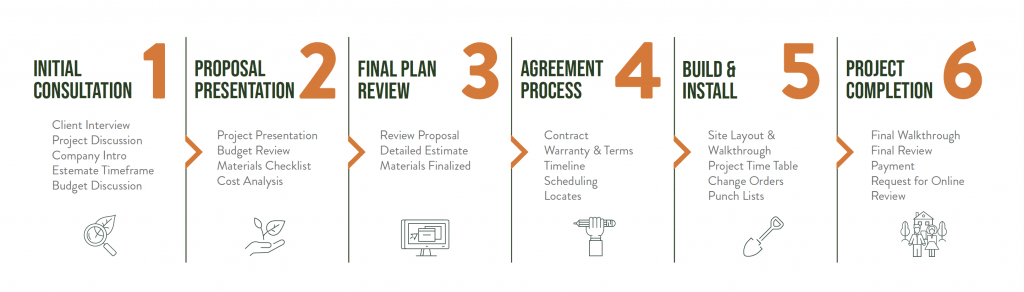
For a detailed look at how the Oasis design and build process works from first consultation through project completion, the Oasis Landscape Design Process page covers each phase in full.
How to Evaluate a Proposal
Once you’ve had consultations with one or more contractors, you’ll receive proposals or estimates. Here’s what to look for beyond the bottom-line number.
- Scope specificity. A strong proposal describes exactly what work will be done, what materials will be used, and what is and isn’t included. Vague language like “patio installation” without material callouts, square footage, or edge detail specs leaves too much room for misinterpretation later.
- Timeline clarity. The proposal should include a projected start date, a general completion window, and some indication of how weather delays or material lead times are handled.
- Warranty terms. Understand what is covered and for how long. Plant warranties, hardscape workmanship warranties, and irrigation system warranties are all worth asking about specifically.
- Payment structure. Most landscape projects are paid in installments tied to project milestones rather than all upfront. Be cautious of any contractor asking for full payment before work begins.
When comparing proposals from multiple contractors, be careful about comparing only on price. A lower bid may reflect thinner margins on materials, less experienced labor, or a scope that quietly excludes things you assumed were included. Compare what’s actually in each proposal before drawing conclusions.
A Realistic Timeline from First Call to Finished Project
For a mid-to-large residential landscape project in the Atlanta area, here is a general picture of what to expect:
- Consultation and site assessment: 1 week from first contact to site visit, depending on the contractor’s schedule.
- Design development: 2 to 4 weeks from consultation to design presentation, depending on project complexity.
- Revisions and approval: 1 to 2 weeks for review, adjustments, and final sign-off.
- Scheduling and material ordering: 2 to 4 weeks from agreement to project start, depending on contractor availability and material lead times.
- Installation: 2 to 4 months for most residential projects, 6 to 12 months for larger or more complex scopes.
From first conversation to finished project, most homeowners are looking at 10 to 18 weeks total. For a spring completion, February is not early. It is right on time.

Frequently Asked Questions
How much does a landscape project cost in Atlanta?
Project costs vary widely depending on scope, materials, and site conditions. As a general guide, focused projects like a new patio or planting installation typically start around $15,000 to $45,000. A full backyard transformation with hardscape, lighting, and plantings generally falls between $50,000 and $90,000. Luxury outdoor living projects with custom features, outdoor kitchens, and extensive hardscape commonly start at $100,000 and scale from there. The best way to get an accurate picture for your specific property is to request a consultation.
Do I need a design before getting a quote?
No. The design and the quote are developed together as part of the same process. A landscape designer will assess your site, discuss your goals, and develop a design that comes paired with a detailed project estimate. You don’t need to arrive with plans.
How far in advance should I book a landscape contractor in Atlanta?
For spring projects, most quality contractors are booking 8 to 12 weeks out from project approval, and the design phase adds another 2 to 4 weeks before that. If you want a finished project by May, starting the conversation in February gives you the best chance of hitting that window.
Can I phase my project if my full budget isn’t available right now?
Yes, phasing is often a smart approach. A good designer will help you think through a phasing plan that makes structural and aesthetic sense rather than just splitting the project arbitrarily. Hardscape infrastructure is typically completed first, with plantings, lighting, or additional features added in subsequent seasons.
What is the difference between a landscape designer and a landscape architect?
A landscape architect holds a licensed professional degree and is typically involved in larger or more technically complex projects that may require permits, grading plans, or engineering input. A landscape designer has specialized training and expertise in the design and installation of residential outdoor spaces. For most residential design-build projects, a skilled landscape designer is the appropriate professional. Oasis Landscapes and Irrigation employs accredited designers with deep experience in Atlanta-area residential projects.
Will my plants survive being installed in late winter or early spring?
In Georgia, late winter and early spring are actually excellent times to install most trees, shrubs, and perennials. Cooler temperatures reduce transplant stress, and plants installed before summer heat arrives have time to establish root systems before facing drought conditions. Our team selects plants suited to your specific site conditions, sun exposure, and USDA hardiness zones 7 and 8, which cover the greater Atlanta area.
Ready to Start the Conversation?
The Oasis Landscapes and Irrigation design team works with homeowners throughout greater Atlanta, including Alpharetta, Canton, Marietta, Roswell, and surrounding communities. If you have a project in mind for this spring or summer, we’d be glad to start with a conversation about your space and your goals.
Request a Consultation: oasislandscape.com/contact/
Related reading: