
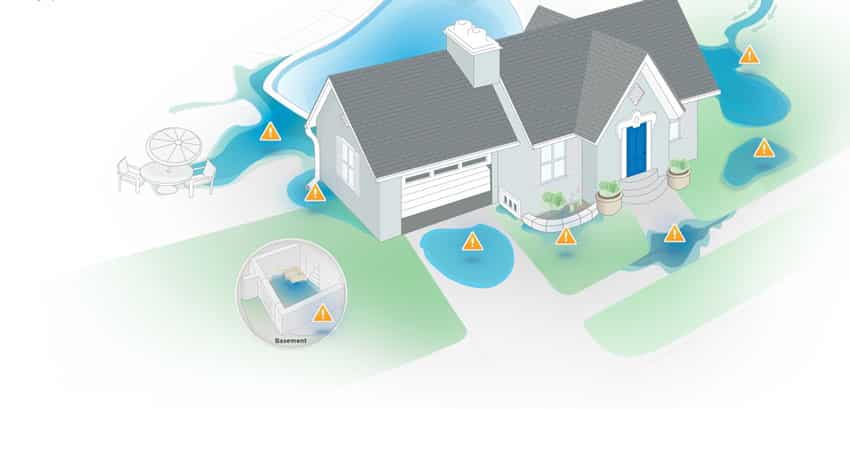
If you’ve lived in Metro Atlanta through even one summer, you already know our summer afternoon thunderstorms are monsoon-level amounts of water dumped in just a few minutes. Thanks to the combination of extreme heat drying up the red clay and leaving it nearly impenetrable, and quick-moving afternoon thunderstorms, which can dump an inch of rain in under thirty minutes, the stormwater doesn’t have anywhere to go and cannot be absorbed quickly. Hence, the excess rainwater pools in low spots, creeps toward foundations, and turns mulch beds into mud pits. At Oasis Landscapes & Irrigation, drainage calls are some of the most common we get, especially from May through September. The good news is that almost every drainage problem has a real, permanent solution once you understand what’s actually happening underground.
This article goes over the reasons behind flooding and drainage issues plaguing metro-Atlanta yards, the tools we use to correct the problems, and the best practices that differentiate a drainage solution that lasts for decades from one that fails after the next heavy rainfall.
Table of Contents
Why Atlanta Yards Struggle with Drainage
Two things work against homeowners here: our clay soil and our topography.
Georgia clay is dense and slow-draining. Water sits at the surface far longer than it would in sandier soil. The rolling grades common throughout the metro area, along with new construction, often disturb natural drainage patterns. The extreme heat bakes the ground to a rock-hard condition, leading to standing water, erosion, and eventually water intrusion near your home’s foundation.
“No, our Georgia clay doesn’t drain well at all. It just doesn’t want to percolate like sand in Florida, or the black soil they’ve got up north.”
— Kevin Paulen, Oasis Landscapes & Irrigation, President
The starting point for solving any drainage issue is understanding slope. In almost every case we investigate, the root cause traces back to where water is, and isn’t, being directed.
Signs You Have a Drainage Problem, and Where It’s Coming From
Erosion, washouts, standing water, and even water making its way into the home itself are the clearest signals that a yard isn’t draining the way it should. It’s not always dramatic. One of the most common complaints we hear directly from homeowners is a backyard that stays wet for days after a storm, wet enough that kids can’t even play in it.
When we investigate, the source often isn’t even on the property in question. On every site assessment, the first thing our crew checks is the gutter downspouts, since a roof sheds a large volume of water fast. A surprising number of the drainage calls we get trace back to a neighbor’s runoff instead of anything happening on the homeowner’s own lot.
We recently walked a job site: a home sitting at the bottom of a slope had a washout under his fence that traced a clean, visible path back to an uphill neighbor’s runoff.
House positioning is extremely important as well. Homes sitting at the bottom of a hill are especially vulnerable. They end up collecting runoff from every higher lot around them. Our advice to homebuyers is blunt: don’t buy at the bottom of the hill, and be wary if a home’s roofline sits at the same elevation as the street.
Start With the Ground Itself: Grading and Slope Correction
Before installing a single pipe, the first thing our team evaluates is grade. Correcting drainage problems by fixing ground slope involves re-grading the soil to create a positive slope of at least 1% moving away from the home or building. Sometimes this is paired with a corrective water system, depending on the severity of the issue.
In practice, that means:
- Establishing positive slope. Water should move downhill and away from your foundation, not toward it.
- Filling in low spots. Depressions in the yard collect and hold water instead of letting it move along.
- Extending downspouts. Gutters that dump water two feet from the foundation. These are often the single biggest contributor to a wet basement or crawlspace. Extending them several feet further, and directing that discharge into the broader drainage plan, makes an outsized difference.
Grading is foundational – literally – because it’s the difference between water sheeting harmlessly across your lawn and water finding every low spot on the way to your house.
When Grading Isn’t Enough: Underground Drainage Systems
Some yards need more help than surface grading can provide. This is particularly true for properties with heavy clay, flat lots, or grades that can’t be adjusted enough to solve the problem on their own. That’s when we may recommend underground drainage systems designed to reroute water below the surface.
French Drains (Curtain Drains). This is the workhorse solution for subsurface seepage. A French drain is a man-made trench lined with a special fabric and filled with gravel, with a perforated pipe laid horizontally inside it to intercept water moving through the soil before it reaches your foundation, basement, or crawlspace.
Catch Basins. Collection boxes set at the low points of a slope, designed to capture standing water at the surface and transition it into a solid underground discharge pipe.
Trench and Channel Drains. Metal or plastic grated channels installed at the base of a slope, or near patios and walkways, to rapidly move heavy surface runoff.
Rigid PVC Piping. Used in combination with catch basins and French drains to carry collected water to its final destination.
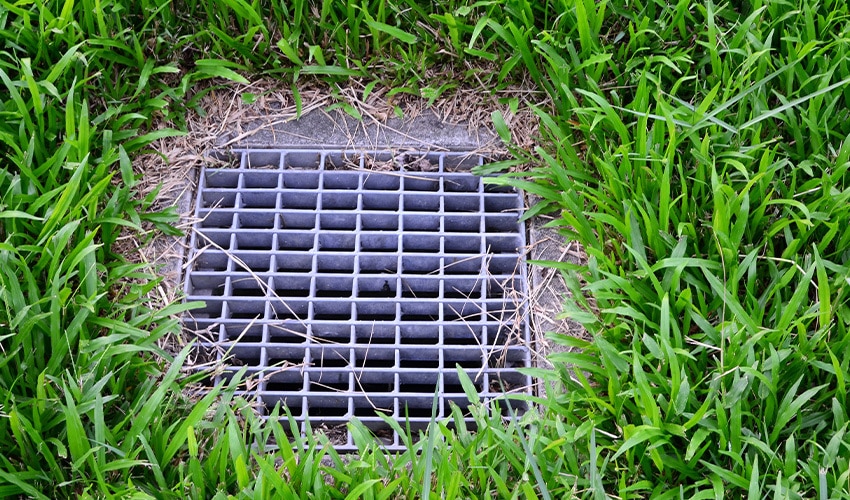
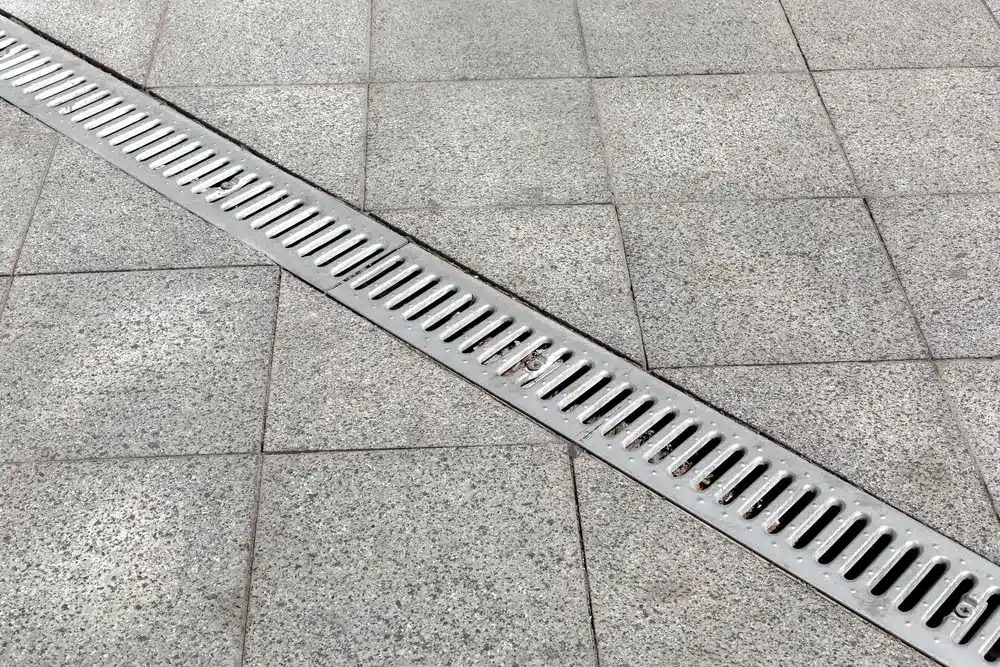
Each of these tools solves a slightly different problem, which is why a proper drainage plan usually blends more than one, matched to how water actually moves across your specific property. When cost is a factor, catch basins and piping are usually our go-to, since they’re the more economical option compared to a dry creek bed — and we’ll often build hybrid systems, where a small dry creek bed captures surface water and feeds into a catch basin, with the rest of the run carried underground by pipe.
For the clay itself, our approach depends on what we’re solving for. When we’re installing sod or new plantings, we till a mix of organic soil and river sand into the clay underneath to help water percolate instead of staying soggy. But when the goal is drainage specifically, rather than a healthy lawn or bed, we lean on gravel-and-pipe systems like French drains, or straight piping.
Project Spotlight: Brookhaven
One project Oasis Landscapes completed in Brookhaven shows how targeted a drainage fix can be. The solution was river rock set into the 18-inch strip between the sidewalk and street that kept washing out.
Natural and Aesthetic Drainage Solutions
Not every drainage fix has to look like infrastructure. For homeowners who want a solution that enhances their landscape, Oasis Landscapes specializes in designing natural-looking drainage features.
- Dry creek beds use stone and strategic plantings to create an attractive, dry-most-of-the-time channel.
- Rain gardens are shallow, planted depressions positioned to catch runoff and let it soak into the ground gradually.
- Swales are wide, shallow, grass-lined trenches that guide water along a gentle path across the property.
- Retaining walls break steep inclines into a series of terraced, flat steps, slowing water velocity and reducing erosion.


Best Practices Our Crews Follow on Every Drainage Project
Drainage work is one of those areas where the difference between a fix that lasts twenty years and one that fails in twenty months comes down to details most homeowners never see. Here’s what we hold every project to:
Maintain grade. We measure the base of every trench with a laser level to ensure a consistent downward incline of at least 1%, which works out to a minimum of a half-inch per foot over the first ten feet away from the house.
Protect the pipe. French drain trenches get lined with non-woven geotextile fabric, which keeps fine dirt and silt from clogging the perforated pipe underneath.
Divert outlets properly. Every drop of water we collect needs somewhere safe to go — a storm drain, dry well, or natural ditch, never simply dumped at the property line where it becomes your neighbor’s problem.
Avoid porous backfill against the foundation. Porous materials against a foundation actually pool water against concrete footings instead of shedding it away.
What to Expect: Timelines, Permits, and the Cost of Waiting
Most of our residential drainage projects run one to five days from start to finish. Permits are where things get genuinely inconsistent: requirements vary by city and county across the metro area, with no shared standard between jurisdictions. Some jurisdictions require a permit even for something as small as a downspout pipe.
The biggest mistake we see homeowners make isn’t picking the wrong fix; it’s waiting too long to address the problem at all — often because most people simply don’t walk the full perimeter of their own house regularly enough to catch a slow-building issue before it becomes a big one.
Ready for a Yard That Handles Atlanta Storms?
Standing water, a soggy lawn, or a damp crawlspace after every storm isn’t something you have to live with. Whether the fix is as simple as re-grading and extending your downspouts, or as involved as a full French drain and catch basin system paired with a rain garden, Oasis Landscaping and Irrigation designs drainage solutions built for the way water actually behaves on Georgia clay. Contact our team for an on-site drainage evaluation, and let’s make sure your yard is ready for whatever the next storm brings.