For a commercial property, a drainage problem is never just a wet patch of grass. It’s a cracked parking lot, a flooded loading dock, a tenant complaint, or a liability claim waiting to happen. At Oasis Landscapes & Irrigation, we work with property managers, HOAs, and commercial owners across metro Atlanta, and an issue involving drainage is consistently one of the most urgent calls we get. Our crews have written as many as nine drainage quotes in a single week during a heavy rain stretch, and the properties calling aren’t just single-family homes. They’re retail centers, office parks, apartment communities, and mixed-use developments, all dealing with the same underlying problem: Georgia’s clay soil and our region’s rolling grades weren’t built to handle the runoff a paved, developed property generates.
Why Commercial Properties Are Exposed to Drainage Failures
Every commercial property is, in effect, a large impervious surface. Parking lots, sidewalks, rooftops, and compacted turf don’t absorb water the way a natural landscape does. Rainfall sheets across pavement and concentrates at low points.
On top of these normal issues, here in Georgia we have dense, slow-draining red clay. Combine the two and you get standing water, erosion, and washouts that show up fast and get expensive if they’re ignored.
The properties most at risk are the ones you’d expect: buildings and parking areas sitting at the bottom of a grade, older developments where drainage infrastructure wasn’t sized for current paving levels, and any site where a neighboring property’s runoff drains onto yours. We advise management companies evaluating a new property acquisition to flag low-lying sites early, since drainage retrofits on those properties tend to be more involved and more costly than on a well-graded site.
Signs Your Property Has a Drainage Problem
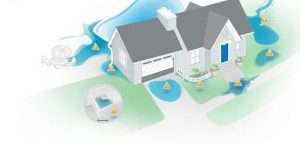
Some good news is that on most commercial sites, warning signs of drainage problems are usually visible before anyone files a complaint. Erosion along landscape beds, washouts near curb lines, and standing water in parking areas are the three clearest signals that water isn’t moving the way it should. The source is often not obvious on-site. A neighboring property’s grading, a clogged or undersized storm drain, or a gutter and downspout system on the building itself can all be sending water somewhere it shouldn’t be.
Why it matters beyond the landscape:
Standing water in a parking lot or walkway is a slip-and-fall liability for tenants, customers, and visitors. Chronic moisture against a building’s foundation or slab risks structural damage that’s far more expensive to correct than the drainage fix itself. And a flooded common area or clogged storm system can put a property out of compliance with local stormwater ordinances, which vary by city and county across the metro area.
Start With the Grade
Just as with residential work, the first thing our team evaluates on a commercial site is grade. Correcting a drainage problem starts with re-grading the soil to establish a positive slope, a minimum of 1% moving water away from buildings, parking areas, and pedestrian paths. Proper grading is sometimes paired with a corrective water system depending on the severity of the issue.
For large, commercial properties, correcting slope usually means:
- Re-establishing positive slope across common grounds, landscape beds, and areas adjacent to the building envelope.
- Correcting low spots in turf and planting areas where water collects instead of moving toward a discharge point.
- Auditing downspouts and roof drainage tying into the property’s broader stormwater plan rather than dumping at the foundation.
Engineered Drainage Systems for Atlanta Commercial Sites
Commercial properties, especially those with heavy clay, large paved areas, or grades that can’t be corrected through re-grading alone, typically need engineered underground systems built to handle a higher volume of water than a residential lot.
French Drains (Curtain Drains). A trench lined with fabric and filled with gravel, with a perforated pipe laid horizontally to intercept subsurface seepage before it reaches a building’s foundation or a below-grade parking structure. Common along retaining walls, hillside common areas, and building perimeters.
Catch Basins. Collection boxes set at low points across a parking lot, courtyard, or drive aisle to capture surface water and route it into an underground discharge system. On commercial sites, catch basins are often sized and spaced to handle the volume coming off large paved surfaces, not just a single downspout.
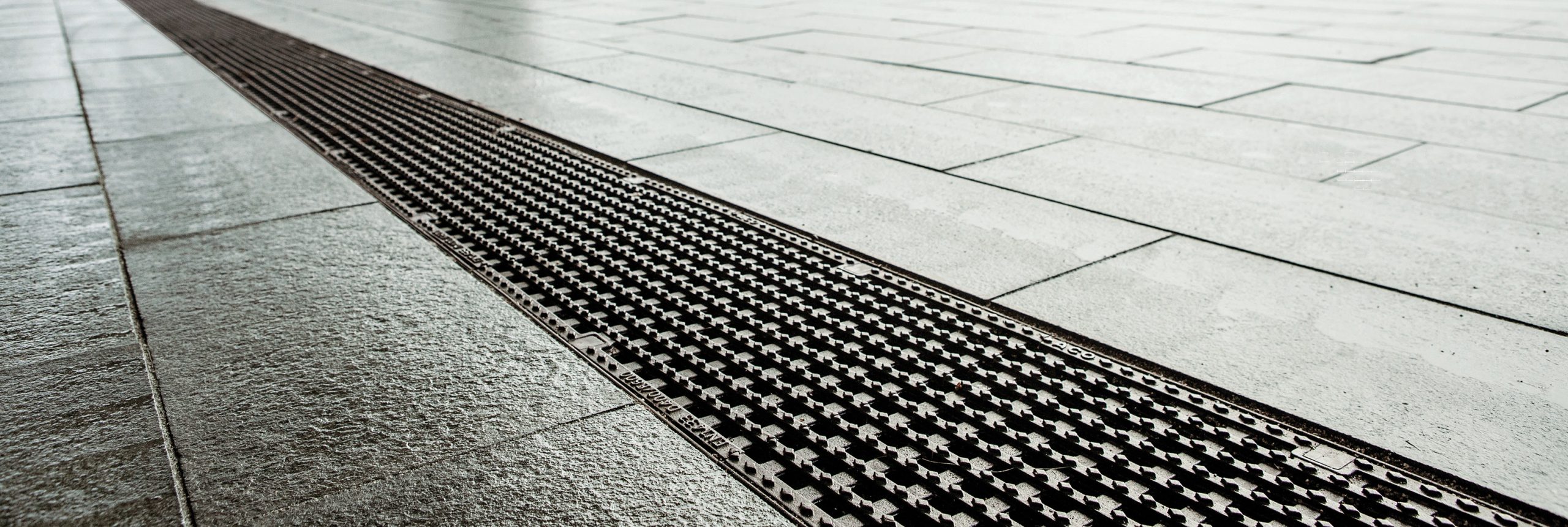
Trench and Channel Drains. Grated channels are installed at the base of a slope or across drive aisles and loading areas, designed to intercept heavy surface runoff quickly, an important feature anywhere vehicle and pedestrian traffic can’t tolerate standing water.
Rigid PVC Piping. Ties catch basins, area drains, and French drains together into one discharge system, engineered to move a commercial property’s water volume without the collapse or root-intrusion risk that comes with aging or undersized pipe.
For properties with detention or retention requirements as part of their stormwater permitting, these systems also need to tie into that infrastructure correctly, which is where we coordinate with a property’s civil engineer or management company on design intent before work begins.
Catch basins and piping are typically more economical to implement than the dry creek beds and natural features covered next, so we’ll often lead with those where the priority is function and compliance over landscape aesthetics.
Project Spotlight: Brookhaven.
One recent project in Brookhaven illustrates how targeted a commercial-grade fix can be. Rather than a full site regrade, our crew installed river rock in an 18-inch strip between the sidewalk and the street to intercept runoff before it ever reached the property line. It’s a simple, precisely placed solution, and it’s exactly the kind of fix that comes from correctly diagnosing where water is entering the site.
HOA Drainage Solutions: Natural Water Management for Common Areas
Commercial properties that accommodate living, such as HOAs and apartments, often need drainage solutions that look natural rather than industrial. For HOAs and mixed-use properties where curb appeal drives leasing and resale value, we often design natural drainage features for common areas, entranceways, and amenity spaces.
- Dry creek beds use stone and strategic plantings to create an attractive channel that carries water during storms and functions as a landscape feature the rest of the time, well suited to entranceways and amenity areas.
- Rain gardens are shallow, planted depressions positioned to catch runoff from parking areas and rooftops, using deep-rooted native plants that thrive on periodic wet conditions.
- Swales are wide, shallow, grass-lined trenches that guide water along common grounds instead of letting it cut its own course across turf and beds.
- Retaining walls break steep inclines into terraced, flat steps, slowing water velocity and preventing the soil erosion that comes with water rushing downhill unchecked across a large site.
These features work well layered on top of proper grading and engineered drainage, giving a property both compliant water management and grounds that support its curb appeal.
Best Practices Our Crews Follow on Every Commercial Project
Drainage work on a commercial property is one of those areas where the difference between a fix that lasts twenty years and one that fails in twenty months comes down to details most property managers never see on a walkthrough. Here’s what we hold every project to:
Maintain grade. We measure the base of every trench with a laser level to ensure a consistent downward incline of at least 1%, a minimum of a half-inch per foot over the first ten feet from any building. Get this wrong and water sits in the pipe instead of flowing to its outlet.
Protect the pipe. French drain trenches get lined with non-woven geotextile fabric, keeping fine dirt and silt from clogging the gravel and pipe underneath, especially important on properties where the system needs to perform with minimal maintenance between service visits.
Divert outlets properly. Every drop of water we collect needs somewhere safe and compliant to go, whether that’s a municipal storm drain, a dry well, or a property’s engineered retention system, never a discharge that simply becomes a neighboring property’s problem or a compliance violation.
Avoid porous backfill against the foundation. Sand or gravel backfilled against a building’s foundation or slab allows water to pool directly against concrete footings, the opposite of what a property needs. Foundation backfill needs to shed water away, not hold it in place.
Protect the Property Before the Next Storm
The most common and costly mistake we see is a management company waiting too long to address a known issue, often until it’s caused real damage to pavement, landscaping, or the building itself, or until it’s become a liability incident or a compliance citation. Addressing drainage proactively is almost always faster and less expensive than repairing what a season or two of unmanaged water can do to a commercial asset.
A serious drainage problem is a liability and asset-value issue. Whether the fix is targeted re-grading, a full engineered catch basin and piping system, or a natural feature that solves the problem while enhancing curb appeal, Oasis Landscapes & Irrigation designs commercial drainage solutions built for how water actually behaves on Georgia clay. Contact our team for an on-site property evaluation, and let’s make sure your property is ready for whatever the next storm brings.